 [TP1]
Learn
What is OTE in trading?
OTE stands for optimal trade entry, an ICT concept. It is the deep part of a pullback: the 62% to 79% retracement of an impulsive leg, where ICT traders look for an entry in the direction of that leg. This guide explains how to measure it, which levels people mean by it, how it differs from the golden pocket, and what one looks like on an NQ chart.
OTE, defined
Start with a leg: price moves with displacement, impulsively, from a swing low to a swing high or from a swing high to a swing low. Then price pulls back. The optimal trade entry is the zone between the 0.62 and 0.79 retracement of that leg, with 0.705 in its middle.
The idea is to enter a continuation of the leg on the pullback rather than at the end of the move. A long is taken deep in the pullback of a leg up, and a short deep in the pullback of a leg down.
How to measure the OTE
- Bullish OTE: after a leg up, draw the fib from the swing low to the swing high. The OTE is where price has given back 62% to 79% of the leg.
- Bearish OTE: after a leg down, draw the fib from the swing high to the swing low. The OTE is where price has retraced 62% to 79% of the drop.
The swing points matter more than the fib tool. Measured from a swing that hasn’t confirmed, the zone moves every time the swing does. The free OTE indicator anchors each leg on confirmed pivots and finalizes it on the bar close, and an ATR-scaled filter ignores shallow retracements.
The OTE levels
Traders quote the OTE in slightly different numbers. These are the levels of the leg that come up, where 0 is the end of the leg and 1 is its start:
| Level | What it is |
|---|---|
| 0.5 | Equilibrium, the middle of the leg. The upper half of the range is premium, the lower half discount. |
| 0.618 (0.62) | Where the OTE begins in ICT's pocket, and where the free OTE indicator's box begins. |
| 0.65 | Where the golden pocket ends: the golden pocket is 0.618 to 0.65. |
| 0.66 | Where the free OTE indicator's box ends. |
| 0.705 | The middle of ICT's pocket, the level most often quoted as the OTE. |
| 0.786 (0.79) | Where ICT's pocket ends. The free OTE indicator treats a body close beyond 0.786 as the zone broken. |
So ICT’s pocket runs from 0.62 to 0.79, and the free OTE indicator draws the tighter 0.618 to 0.66 box, keeps the rest of the grid on the chart, and uses 0.786 as the line that breaks the zone.
OTE vs the golden pocket
The golden pocket is the 0.618 to 0.65 retracement of a move. It sits inside the OTE, at its shallow end. Both come from the same fib drawn on the same swing, so on a chart they overlap; the OTE reaches further, to 0.79.
Golden Pocket Pro, a partner indicator from Big Gains Club, plots the 0.618 / 0.65 golden pocket and runs its entry model around it. Its page explains the golden pocket: Golden Pocket Pro.
OTE, premium and discount
Inside a dealing range, a swing high to a swing low, the upper half is premium, the lower half is discount, and the 50% line is equilibrium. The OTE is always past equilibrium. In a leg up it sits in discount, where a long is cheap relative to the leg; in a leg down it sits in premium, where a short is.
That is why the 0.5 level is on the grid. A pullback that hasn’t crossed the middle of the leg hasn’t reached the OTE yet.
What makes an OTE worth watching
- Displacement first. An OTE is only measured after an impulsive leg. A fair value gap left inside the leg is the usual sign that it was one. See what a fair value gap is.
- A PD array inside the pocket. Traders look for an order block or a fair value gap sitting inside the 62% to 79% zone, so the retracement level and the array line up. See what order blocks are.
- A line that ends it. The free OTE indicator removes a zone once a candle body closes beyond 0.786, with an adjustable tolerance. A wick through it doesn’t.
The OTE is one part of a model, not the model. Where it fits beside liquidity, structure and the sessions is in what ICT trading is.
OTE on a chart: NQ, 15-minute
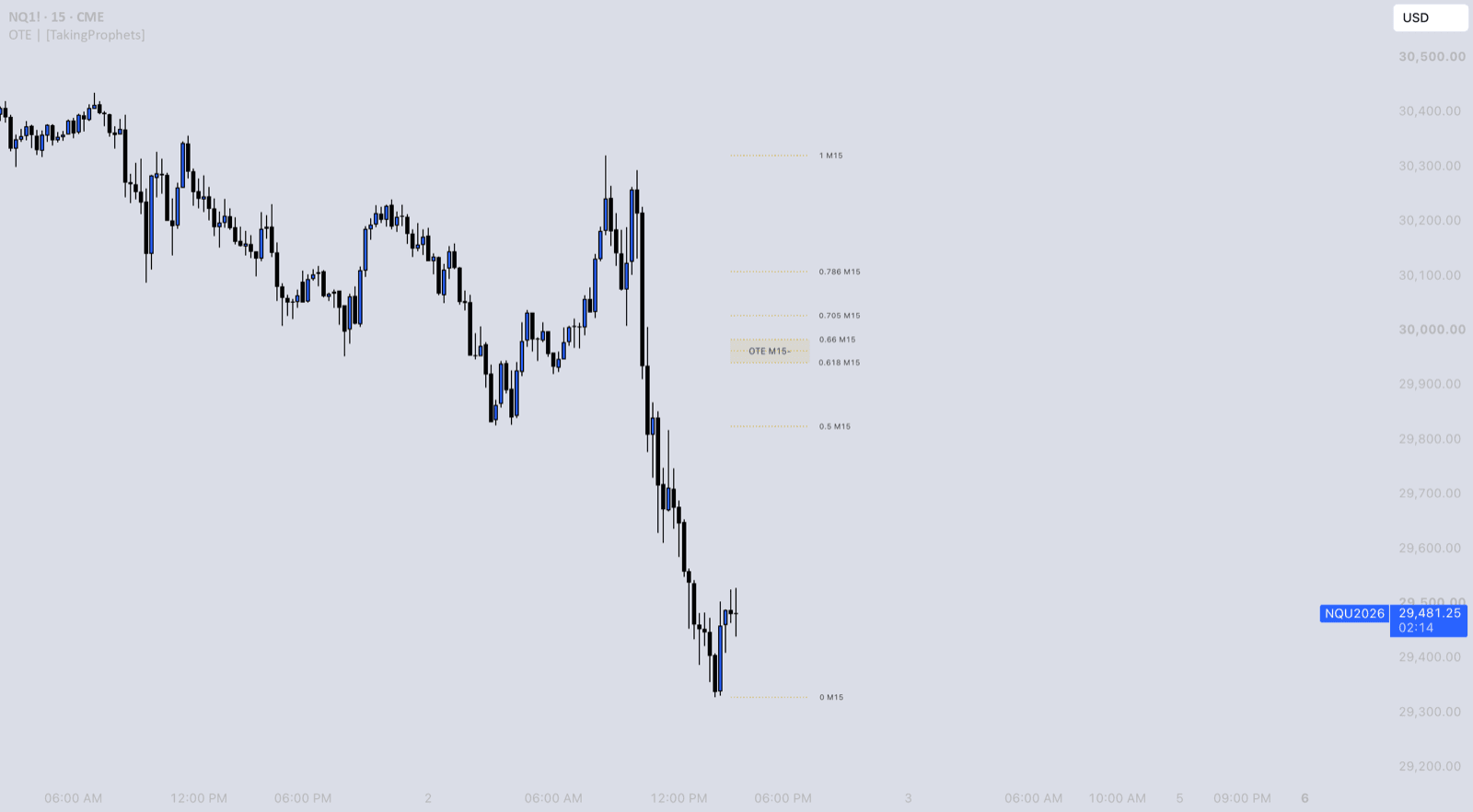
The leg runs down from the swing high, marked 1, to the swing low, marked 0. Because the leg is down, the retracement levels count up from the low: 0.5 is the middle, and the OTE M15 box sits between 0.618 and 0.66, in the premium half of the leg. Each level is tagged M15, the 15-minute timeframe of this chart. A body close above 0.786 would break the zone.
OTE questions
What does OTE stand for in trading?
Optimal trade entry: ICT’s name for the 62% to 79% retracement of a displacement leg.
Is the OTE 0.705 or 0.62 to 0.79?
Both are used. The zone is 0.62 to 0.79, and 0.705 is its middle, the single level most often quoted. The free OTE indicator draws 0.618 to 0.66 as its box and keeps 0.705 and 0.786 on the grid.
Is the OTE the same as the golden pocket?
No. The golden pocket, 0.618 to 0.65, is the shallow end of the OTE. The OTE runs on to 0.79.
Does the free OTE indicator repaint?
No. Each leg anchors on confirmed pivots and finalizes on the bar close, so a drawn zone doesn’t move mid-bar.
Free indicators for the OTE
- OTE: Finds the most recent qualifying swing and draws its 0.618 to 0.66 OTE box, an optional CE midline and a seven-level fib grid.
- FVG: Marks the fair value gaps a displacement leg leaves behind, the usual sign that the leg qualifies.
- Order Blocks: Marks order blocks after each structure shift, and HTF Order Blocks maps them from up to five higher timeframes: arrays traders look for inside the pocket.
Educational content. An OTE describes where a pullback is; it doesn’t predict what price will do. Futures trading involves substantial risk of loss. See our risk disclosures.