 [TP1]
Learn
What is an inverse fair value gap (IFVG)?
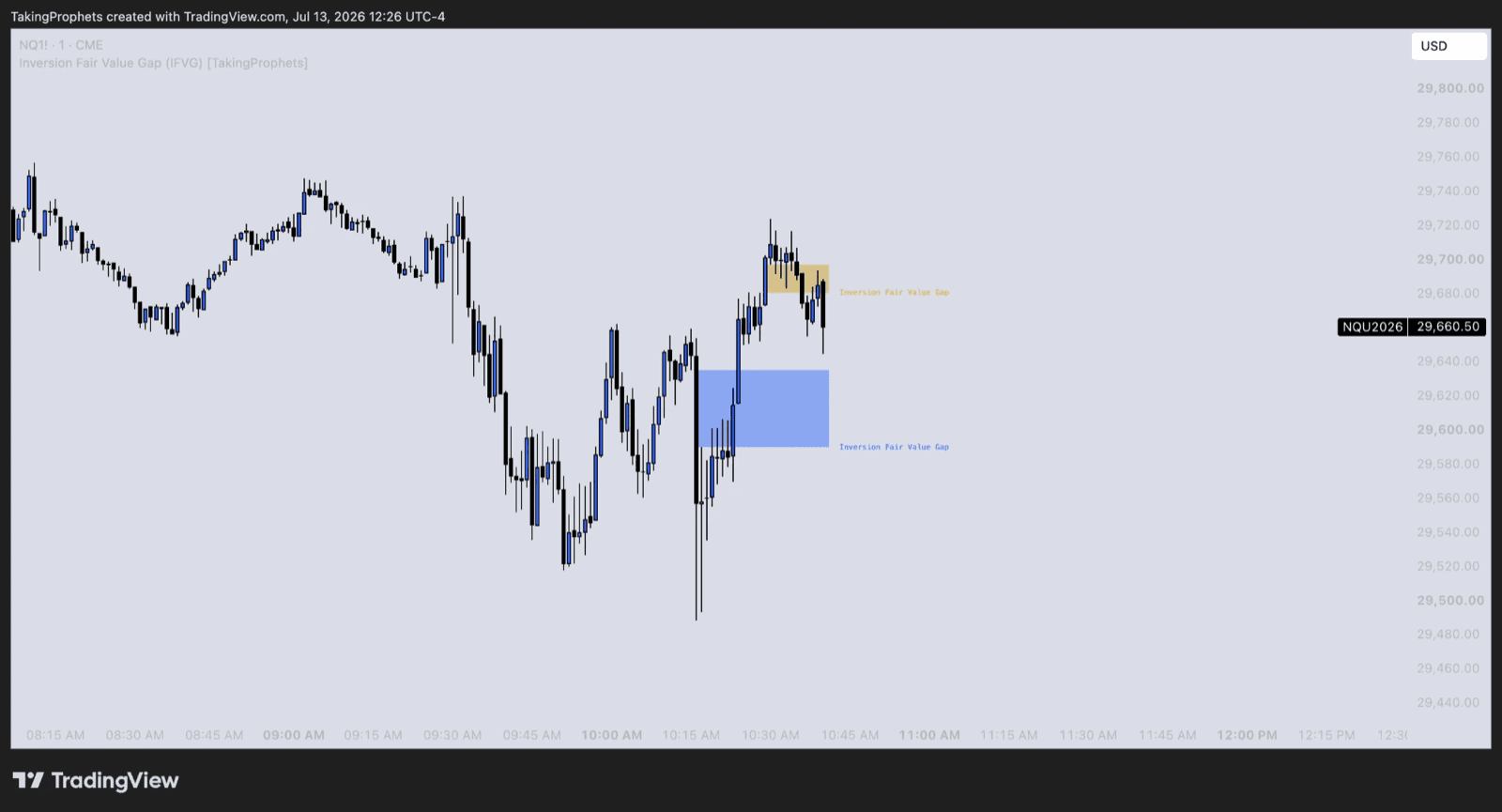
An inverse fair value gap, or inversion fair value gap, is a fair value gap that price has closed through. Once it is closed through, the gap is read the other way round: a former area of support starts acting as resistance, and a former area of resistance as support. This guide shows how an inversion forms, what counts as one, and how an IFVG differs from an FVG.
From fair value gap to inversion
A fair value gap is a three-candle imbalance. In a bullish gap, the third candle’s low is above the first candle’s high, and the space between them was traded only by the middle candle. A bearish gap is the mirror image. A bullish gap below price is studied as support, a bearish gap above price as resistance.
A gap doesn’t always hold. When a candle closes through it, the gap has failed in its original direction, and it flips. That flipped gap is the inversion: the same zone on the chart, now read as the opposite type.
Bullish and bearish IFVGs
An IFVG takes the direction it is read in after the flip, which is the opposite of the gap it came from.
- Bearish IFVG: a bullish fair value gap that price closed below. The zone that was support is now studied as resistance when price trades back up into it.
- Bullish IFVG: a bearish fair value gap that price closed above. The zone that was resistance is now studied as support when price trades back down into it.
What counts as an inversion
A close, not a wick. A wick that pokes through a gap and comes back is a fill, not an inversion. The inversion is a candle that closes through the gap. Our free Inversion FVG indicator confirms both the gap and its inversion on the bar’s close, so a box never appears intrabar and disappears again. iFVG Ultimate+ asks for more: a full candle body closing through the gap.
Within a window. A gap that is never closed through never inverts. Inversion FVG waits for each gap to invert within a window you set, and discards one that doesn’t before it is ever drawn, so the chart shows only inversions that happened.
Size. Three candles meet the gap rule all the time, so a gap a tick tall would count as much as one that spans a whole move. Inversion FVG filters gaps by size against the average true range, from removing micro gaps to keeping only large ones, and its Series mode merges adjacent gaps into one zone.
Inside an inversion: the quadrants
An inverted gap can be split like any fair value gap: into quadrants at 0, 25, 50, 75 and 100 percent of its height. The 50% line is the gap’s consequent encroachment, its midpoint. The lines show how deep into the inverted zone price trades when it comes back. Inversion FVG and Reclaimed FVG can draw these lines inside each zone.
What happens after an inversion
Reclaimed. Sometimes price takes an inverted gap back: it closes through it again, in the gap’s original direction. That is a reclaimed fair value gap. Reclaimed FVG follows every gap through each state, from pending to inversion, reclaim and invalidation, and removes a zone once it is invalidated.
Balanced. When the move that closes through a gap leaves a new gap of its own, in the other direction, the zone where the inverted gap and that new gap overlap is a balanced price range (BPR). If the two gaps share no price, there is no BPR.
IFVG vs FVG
A fair value gap is the imbalance as it forms. An inverse fair value gap is the same zone after price has closed through it, read in the other direction.
- FVG: three candles, the first and third not overlapping. Bullish below price as support, bearish above as resistance.
- IFVG: a gap price has closed through. The old support now acts as resistance, or the old resistance as support.
- Reclaimed FVG: an IFVG that price closes back through in the gap’s original direction.
IFVG or implied FVG? Some sources use the same letters, IFVG, for an “implied fair value gap”, which is a different idea. On this site, and in every indicator linked here, IFVG means the inversion fair value gap described above.
IFVGs in entry models
An inversion on its own describes one event. Some models use it as their last step, after other conditions line up. Two common ones: the inversion after a liquidity sweep, and the inversion after an SMT divergence between correlated markets.
- iFVG Ultimate+: A sequence: a liquidity sweep of a prior swing high or low, a displacement that leaves a fair value gap, then a full candle body closing through that gap after the raid. Confirmed inversions are tracked until they complete or are invalidated.
- Motion Model+: An external SMT divergence, an internal SMT at the same swing, then the first inversion fair value gap in the same direction within ten minutes of the internal one.
- ICT Pro+: Marks IFVGs as they form, beside CISD shifts, SMT divergence, session levels and higher timeframe PD arrays.
Before risking money on any model, you can replay it on real history in the Backtester and see how it behaved.
Free indicators that mark it
- Inversion FVG: The moment a gap inverts to the opposite character, confirmed on the close, as a clean box with optional quadrant lines.
- Reclaimed FVG: Every gap followed through inversion, reclaim and invalidation, each state with its own color.
- HTF BPR: Where a bullish and a bearish gap overlap, sourced from your higher timeframes: the balanced price range.
- iFVG guide: Four tips for trading inversion fair value gaps, as a free PDF.
Educational content. An inverse fair value gap describes what price did; it doesn’t predict what price will do. Futures trading involves substantial risk of loss. See our risk disclosures.